




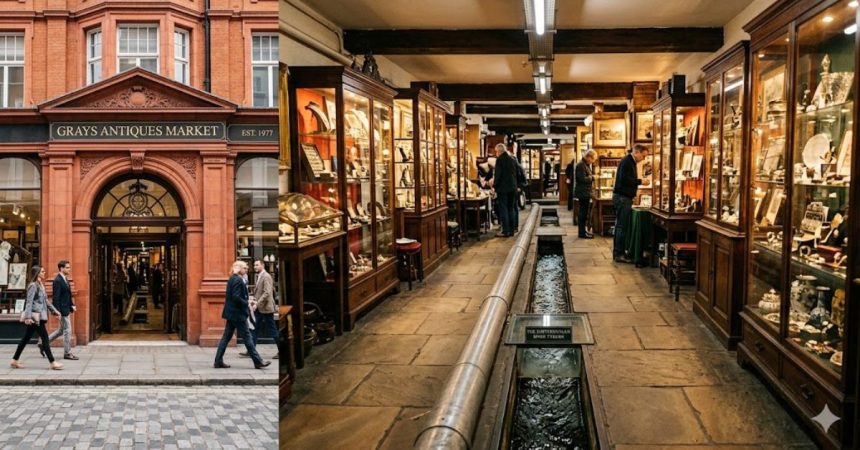
Greys Antiques Market London A Journey Through Time and Treasures
Back in 1977, an eccentric property developer named Bennie Gray walked into a flooded, abandoned Victorian basement. It was tucked away just off Oxford Street. The place was a total mess. Decades earlier, a company called John Bolding & Son used it to show off fancy ornamental toilets. But when Gray looked inside, he found six feet of murky water.
This wasn’t a broken pipe. It was the River Tyburn. This is one of London’s ancient, hidden rivers. Engineers buried it alive under brick and concrete centuries ago as the city grew. Most people would have poured cement over it and walked away. Gray didn’t. He decided to build right on top of it. He routed the water through a tiny open channel inside the building.
That strange decision became the literal foundation for the Greys Antiques Market London. Today, walking down into this Mayfair spot feels like stepping into a time machine. It is a labyrinth. Objects don’t just sit on shelves here. They tell stories. And if you listen closely, you can hear them.
The Curatorial Gravity of Mayfair
Picture this. You are walking down Davies Street toward the Bond Street tube station. The noise of modern London is everywhere. Cars honk. Shoppers rush past carrying bags from fast-fashion chains. It is loud, fast, and a bit overwhelming.
But then you step inside the red terracotta entrance of the Greys Antiques Market London.
Instantly, the city vanishes. The air feels different. The noise drops away completely. It is replaced by the soft hum of whispers and the faint clinking of old keys.
Why is a place like the Greys Antiques Market London sitting on some of the most expensive real estate in the world? It comes down to a simple concept. Businesses that do the same thing love to stick together. Grays sits right in the middle of a massive historical gravity well. You have Sotheby’s and Christie’s just blocks away. You have the high-end galleries of New Bond Street right around the corner.
This creates an ecosystem of trust. When incredibly rare estate pieces move through major auction houses, things get left behind. Oddities, fragments, and highly specific treasures wash up right here. They land in the velvet-lined glass cases of Grays.
Anatomy of the Labyrinth: What Lies Inside
To really get the Greys Antiques Market London, you have to understand how it’s laid out. The complex is split into two parts: the Main Building and the Mews. Inside, you will find about 100 independent dealers. Together, they hold thousands of years of human history in their heads.
- The Ground Floor: This is the glittering heart of the market. It is packed with European estate jewelry. You will see heavy mourning rings from the Stuart era. Right next to them, you’ll spot geometric platinum rings from the Art Deco movement.
- The Mews Basement: Walk down the stairs. The vibe changes. It gets more eclectic and tactile. This is where you can actually see the River Tyburn flowing through a narrow metal conduit. Surrounding the water are stalls filled with Islamic antiquities, old sea navigation tools, vintage watches, and rare porcelain.
The market keeps its own pace. It is open Monday through Friday from 10:00 AM to 6:00 PM. A few dealers open up on Saturdays too. It isn’t a place for cheap plastic souvenirs. It is built for people hunting for real pieces of the past.
Trust in a World of Fakes
We live in a world where anyone can buy a fake Rolex online in five minutes. Counterfeits look terrifyingly real now. That is exactly why a physical space like the Greys Antiques Market London still matters so much. It is all about real human expertise and trust.
The dealers here are not casual thrift shop owners. They are obsessive historians.
An amateur looks at a piece of silver and just sees a shiny plate. A dealer at Grays looks at the tiny stamped hallmark. They instantly tell you the name of the silversmith. They know the city it came from, the exact year it was made, and how much tax the maker paid on the metal.
Why You Can Trust the Sellers
The authority of the Greys Antiques Market London comes down to three simple things: Greys Antiques Market London
- Family Traditions: Many of these stalls have been passed down through generations. These families have a tactile knowledge of old materials. They know how an item should feel in your hand. An AI algorithm can’t copy that.
- The Unofficial Guild: The dealers sit just feet apart from each other. If someone tried to sell a fake, everyone would know instantly. They protect each other’s reputations.
- Face-to-Face Checking: You can pick up a 2,000-year-old Roman coin. You can look at the worn edges through a magnifying glass. You get to talk directly to a person who has spent forty years studying ancient Rome.
The Psychology of the Object
I always think about how we make decisions. Sometimes we look at something and just know it’s right. Our brains spot tiny details before we can even explain them. That instinct is what draws people into the Greys Antiques Market London.
When you buy an old Edwardian engagement ring or a vintage watch here, you aren’t paying for the gold or the gears. You are paying for the patina. You are paying for the tiny scratches and the faded paint.
These marks are the physical receipts of human life. We live in a world full of mass-produced plastic. Everything is digital. Everything is temporary. But these objects are different. They are heavy. They are real. They anchor us to history.
Conclusion: The Living Archive
At the end of the day, the Greys Antiques Market London is not just another expensive shopping mall in Mayfair. It is a living archive. It is a place where the past is kept alive, argued over, and saved for the next generation.
The lost River Tyburn still flows under the floorboards in the basement. In the exact same way, the history of human creativity hums inside the glass cases upstairs.
Maybe you are a museum curator looking for something rare. Maybe you want to invest in something you can actually hold. Or maybe you just want to escape the modern world for an hour. The Greys Antiques Market London gives you a rare gift. It lets you slow down, look closely, and hear the stories of the people who came before us.