




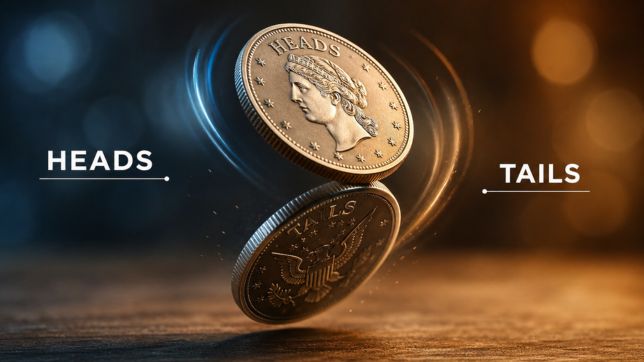
Introduction Heads or Tails
Few games are as simple, universal, and timeless as “heads or tails.” With nothing more than a coin and a quick flip, this classic method of decision-making has been used for centuries across cultures. Whether settling a friendly debate, starting a sports match, or making a quick choice, the coin toss carries a sense of fairness and chance that people instinctively trust.
But behind this seemingly simple act lies a fascinating blend of history, probability, psychology, and even strategy. In this article, we’ll take a deeper look at the origins of heads or tails, how it works, why it’s so widely used, and what makes it more interesting than it first appears.
The Origins of the Coin Toss Heads or Tails
The concept of flipping a coin to make decisions dates back thousands of years. In ancient Rome, the game was known as “navia aut caput,” meaning “ship or head,” referring to the designs stamped on Roman coins. People would toss coins to resolve disputes or make decisions quickly and fairly.
Similarly, in medieval England, the coin toss was called “cross and pile,” referencing the cross symbol on one side of the coin. Over time, as coin designs evolved, the terminology shifted to “heads or tails,” which is now the standard phrase in many parts of the world.
Despite its simplicity, the coin toss became an accepted method for impartial decision-making because it relies entirely on chance. There’s no skill required, no bias, and no predictable outcome, at least in theory.
How the Coin Toss Works
At its core, a coin toss is a binary event. The coin has two sides:
- Heads (usually featuring a portrait or emblem)
- Tails (typically showing a symbol or design)
When flipped into the air and allowed to land freely, the coin has an equal probability of landing on either side. This creates a 50/50 chance for each outcome, making it one of the simplest examples of probability in action.
The process typically involves: Heads or Tails
- One person calling “heads” or “tails” while the coin is in the air.
- The coin landing on a surface or being caught and revealed.
- The result determining the winner or decision.
Because of its simplicity, the coin toss is widely used in situations where fairness and neutrality are essential.
Probability and the Science Behind It Heads or Tails
From a mathematical standpoint, a fair coin toss has a probability of: Heads or Tails
- 50% chance of landing on heads
- 50% chance of landing on tails
This makes it a perfect example of a random event. However, real-world physics introduces some nuance. Factors like the force of the flip, air resistance, and the surface where the coin lands can slightly influence the outcome.
Studies have even suggested that coins may land on the same side they started on slightly more often than pure chance would suggest. However, in everyday use, these variations are so small that the coin toss is still considered effectively fair.
The coin toss is often used in probability theory and statistics as a basic model to explain concepts such as: Heads or Tails
- Randomness
- Independent events
- Expected outcomes
For example, flipping a coin 100 times should theoretically result in about 50 heads and 50 tails, though short-term results may vary.
The Role of Coin Toss in Sports
One of the most visible uses of the coin toss is in sports. It’s commonly used to decide which team goes first, chooses sides, or starts play.
In cricket, for example, the coin toss determines which team will bat or bowl first. This decision can have a significant impact on the game, especially depending on weather conditions and pitch behavior.
In football (soccer) and American football, the coin toss decides which team gets possession or chooses the direction of play. These decisions can influence strategy and momentum right from the start.
Because both teams have an equal chance, the coin toss is seen as a fair way to begin competition without giving either side an advantage.
Coin Toss in Everyday Decision-Making
Beyond sports, people use coin tosses in everyday life more often than they realize. When faced with two equally appealing options, flipping a coin can provide a quick and unbiased decision.
For example: Heads or Tails
- Choosing between two restaurants
- Deciding who goes first in a game
- Settling minor disagreements
- Making spontaneous choices
Interestingly, some people use the coin toss not just for the outcome, but for the feeling it reveals. While the coin is in the air, they may realize which result they are secretly hoping for. This insight can help them make a more confident decision.
Psychological Aspects of the Coin Toss
The coin toss is more than just a random event. It also taps into human psychology in interesting ways.
Perception of Fairness
People trust the coin toss because it removes personal bias. Since neither person controls the outcome, it feels fair and impartial. This makes it an effective tool for resolving disputes.
The Illusion of Patterns
Humans naturally look for patterns, even in random events. If a coin lands on heads several times in a row, people might believe tails is “due” next. This is known as the gambler’s fallacy.
In reality, each coin toss is independent. The outcome of previous flips has no effect on the next one.
Emotional Reactions
Even though the coin toss is random, people often feel excitement, tension, or disappointment based on the result. This emotional response adds to the appeal of the game.
Variations of the Coin Toss Game Heads or Tails
While the basic concept remains the same, there are several variations of the coin toss used around the world.
Best of Series
Instead of a single toss, players may agree to multiple rounds, such as “best of three” or “best of five.” This adds a layer of excitement and reduces the impact of a single random outcome.
Catch and Reveal
In some cases, the coin is caught and flipped onto the back of the hand before being revealed. This adds a bit of flair and suspense to the process.
Spinning Coins
Some people spin coins on a flat surface instead of tossing them. The result is determined when the coin falls. While less common, it still follows the same principle of randomness.
Is the Coin Toss Truly Random?
While the coin toss is widely accepted as random, scientists and researchers have explored whether it is truly unpredictable.
In controlled conditions, it’s possible to influence the outcome of a coin toss with precise technique. Skilled individuals can flip a coin in a way that increases the likelihood of a specific result. However, this requires a high level of control and consistency that most people don’t have.
In everyday situations, the coin toss remains effectively random. Any slight bias is negligible, making it a reliable method for fair decision-making.
Coin Toss in Technology and Digital Spaces
The concept of heads or tails has also been adapted into digital environments. Many apps and websites now offer virtual coin toss features that simulate the experience.
These digital tools use random number generators to produce results, ensuring fairness and unpredictability. They are especially useful when a physical coin is not available.
In programming and computer science, the coin toss is often used as a metaphor for binary decisions and random processes. It plays a role in algorithms, simulations, and even artificial intelligence models.
Cultural Significance of Heads or Tails
The coin toss holds cultural importance in many societies. It represents chance, fate, and the idea that some outcomes are beyond human control.
In literature and film, the coin toss is often used as a dramatic device. A character may flip a coin to make a life-changing decision, symbolizing the role of luck and uncertainty.
In some traditions, coin tossing is even used in rituals or symbolic acts, reflecting deeper beliefs about destiny and choice.
Teaching Tool for Education
Because of its simplicity, the coin toss is widely used as a teaching tool in classrooms. It helps students understand basic concepts in mathematics and science.
Teachers use coin toss experiments to demonstrate:
- Probability
- Data collection
- Statistical analysis
- Random variables
By recording the results of multiple tosses, students can observe how outcomes align with theoretical probabilities over time.
The Coin Toss and Decision Theory
In decision theory, the coin toss is sometimes used as a method to break ties when options are equally valuable. It removes overthinking and encourages action.
Interestingly, the act of flipping a coin can clarify preferences. If someone feels disappointed with the result, it may indicate that they actually preferred the other option all along.
This makes the coin toss not just a tool for randomness, but also a way to better understand one’s own desires.
Fun Facts About Coin Tosses
- A coin toss is often used in major sporting events to determine starting positions.
- Some coins are slightly biased due to design differences, though the effect is minimal.
- Professional magicians can manipulate coin tosses with practice.
- The longest recorded streak of the same coin toss result in experiments has surprised researchers, highlighting the unpredictability of randomness.
Conclusion Heads or Tails
“Heads or tails” may seem like a simple game, but it carries a rich history and deeper significance than most people realize. From ancient decision-making methods to modern sports and digital tools, the coin toss remains a trusted symbol of fairness and chance.
Its appeal lies in its simplicity. With no rules to learn and no skills required, anyone can participate. Yet, beneath that simplicity lies a fascinating mix of mathematics, psychology, and human behavior.
Whether you’re using it to settle a debate, start a game, or make a quick decision, the coin toss continues to be one of the most reliable and universally understood methods of choosing between two options.
So the next time you flip a coin, remember, it’s not just heads or tails. It’s a small moment where chance, choice, and curiosity come together in a single spin.